Why Understanding Your Emotions Is Not Enough: How to Build Emotional Resilience Through the Mind-Body Connection
The Emotional Journey of Being Human
Emotions are a fundamental part of the human experience. They are not reserved for the highly sensitive, the wounded, the artistic, or the spiritually inclined. They belong to all of us.
From the moment we enter the world, emotion is present. Most infants arrive through crying—not as a sign that something is wrong, but as one of the first signs of life. The body breathes, the lungs open, sound emerges, and human expression begins.
As we approach the end of life, emotion is often present again in complex and profound ways. People may experience peace, sadness, fear, gratitude, regret, anger, tenderness, or even unexpected moments of clarity. Our emotional life does not disappear simply because the body is changing. In many ways, it becomes even more visible.
Between birth and death, we live within a continual stream of emotional experience.
We experience joy, disappointment, longing, irritation, hope, envy, love, grief, shame, delight, resentment, courage, and uncertainty. Some emotions pass quickly. Others seem to remain with us long after the event that gave rise to them has ended.
Yet despite how central emotions are to being human, many of us were never taught how to meet them with steadiness, wisdom, and depth.
We were taught to behave.
We were taught to succeed.
We were taught to be polite.
We were taught to move on.
We were taught to stay strong.
But many of us were never taught how to truly process what we feel.
What Most of Us Overlook
Over the past decade, there has been growing awareness that emotions can influence our mental, physical, and relational wellbeing. More people now recognize that stress, unresolved hurt, chronic resentment, fear, grief, or emotional suppression may affect how we sleep, eat, communicate, make decisions, and experience our bodies.
This awareness is important.
But awareness alone is not always transformation.
We can understand why we feel something and still remain caught in the same pattern. We can explain our childhood, our triggers, our relationship dynamics, our habits, and our fears—and still feel emotionally stuck.
This is one of the most important distinctions in emotional wellbeing:
Understanding an emotion is not the same as integrating it.
Insight matters. Language matters. Reflection matters. But the body, mind, and deeper self often need more than explanation. They need a new experience of safety, presence, regulation, and inner relationship.
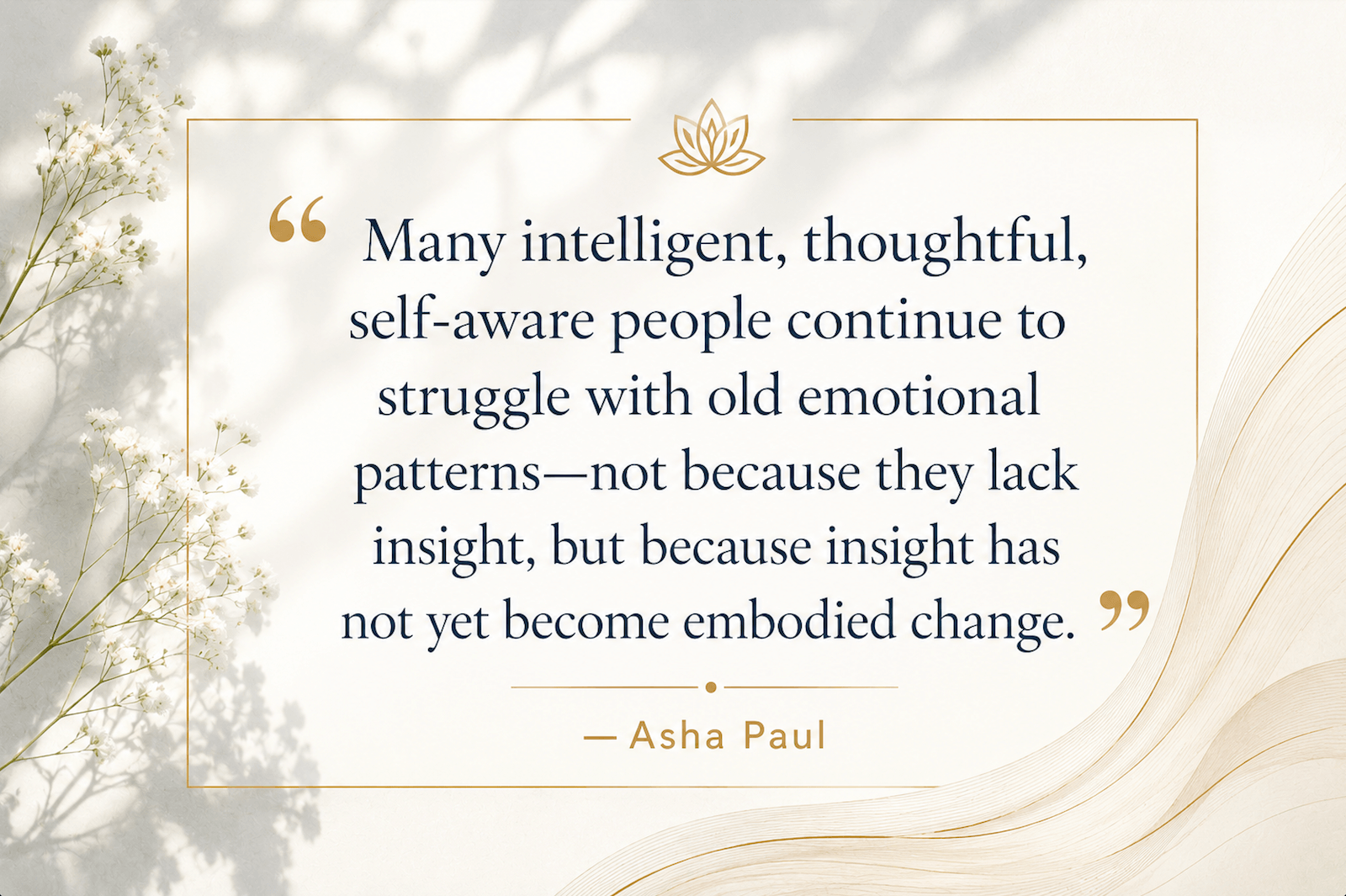
This is why many intelligent, thoughtful, self-aware people continue to struggle with old emotional patterns. It is not because they lack insight. It is often because insight has not yet become embodied change.
Common Ways We Avoid Feeling
When emotions feel uncomfortable, overwhelming, inconvenient, or unfamiliar, many of us turn toward coping mechanisms. These responses are often not intentional. They are adaptive strategies we may have learned over time.
Some people overeat, not because they lack discipline, but because food has become a way to soften emotional intensity.
Some people numb through excessive television, scrolling, shopping, busyness, or constant distraction.
Some people deflect with humor, sarcasm, intellectual conversation, or self-deprecation.
Some people rationalize, creating explanations that keep them from feeling the raw truth of what is actually present.
Some people use toxic positivity, quickly replacing pain with affirmations, gratitude, or spiritual language before the emotion has been honestly acknowledged.
These strategies may offer temporary relief. But they rarely create true freedom.
The emotion may go quiet for a while, but quiet is not the same as resolved. The body may continue to carry tension. The mind may continue to replay stories. The nervous system may continue to anticipate danger. Relationships may continue to activate old wounds.
This is why emotional resilience is not simply about staying calm. It is about developing the capacity to meet life more honestly.
Emotions Are Not the Enemy
One of the great misunderstandings of modern life is that difficult emotions are problems to eliminate.
Anger must be controlled.
Sadness must be overcome.
Fear must be conquered.
Grief must be moved through quickly.
Shame must be hidden.
Anxiety must be fixed.
But emotions are not always the enemy. They are signals. They are messengers. They are movements of energy, memory, meaning, and perception. They often reveal where something in us needs attention, care, boundaries, truth, or healing.
This does not mean every emotion should be obeyed. Emotions can be distorted by old experiences, fatigue, hunger, hormonal changes, trauma, stress, poor sleep, or mental habits. Even then, they are worth listening to with discernment.
An emotion may not always tell us the whole truth.
But it often tells us where to look.
Why the Body Matters
Many of us try to resolve emotions only through thinking. We analyze what happened. We talk about it. We journal. We identify the pattern. We name the trigger.
All of this can be valuable.
But the body may still be holding the emotional imprint.
A tight chest.
A clenched jaw.
A stomach that knots before a difficult conversation.
A wave of fatigue after conflict.
A sudden craving after feeling rejected.
A racing heart when nothing dangerous is happening.
A collapse in energy after remembering something painful.
The body often speaks before the intellect catches up.
This is why emotional wellbeing cannot be separated from the body. We do not merely think our lives. We feel them, digest them, brace against them, soften into them, and carry them.
As a holistic health practitioner and integrative health coach, I see emotional wellbeing as part of the larger landscape of healthy aging and human flourishing. Food, sleep, movement, relationships, breath, thought patterns, stress, meaning, and spiritual connection all influence the inner environment in which emotions are processed.
This does not mean food or lifestyle alone can resolve deep emotional pain. Nor does it mean emotional work replaces appropriate medical or mental health care. It does mean that the body is part of the conversation.
We cannot build emotional resilience while ignoring the body that carries our emotional life.
The Limits of Intellectual Understanding
Today, most of us are far more emotionally literate than previous generations. We know words like trauma, trigger, attachment, boundaries, nervous system, regulation, shadow, resilience, and self-awareness.
This language can be empowering.
But there is also a subtle danger. Sometimes we begin to collect emotional vocabulary without cultivating emotional capacity.
We can speak beautifully about our wounds and still react from them.
We can understand our patterns and still repeat them.
We can name our triggers and still be ruled by them.
We can know the origin of our pain and still not know how to meet it when it rises in the body.
This is why the next stage of emotional growth is not merely more information. It is integration.
Integration asks:
Can I stay present when discomfort arises?
Can I feel without becoming overwhelmed?
Can I pause before reacting?
Can I listen to my body without fearing it?
Can I tell the truth without collapsing into shame?
Can I care for myself without abandoning others?
Can I hold both compassion and accountability?
Can I meet life with more clarity, choice, and inner steadiness?
These are not just intellectual skills. They are cultivated capacities.
Emotional Patterns and Healthy Aging
When we speak about healthy aging, we often focus on food, exercise, hormones, bone density, muscle mass, sleep, and metabolic health. These are deeply important.
But emotional patterns also shape how we age.
Chronic resentment can harden the inner life.
Unprocessed grief can drain vitality.
Perfectionism can keep the nervous system under pressure.
People-pleasing can disconnect us from our own needs.
Fear can narrow our choices.
Shame can silence our voice.
Unresolved hurt can affect how we love, trust, eat, sleep, and show up in the world.
Healthy aging is not only about living longer. It is about becoming more whole as we live.
It is about preserving vitality, yes—but also wisdom.
Energy, yes—but also emotional freedom.
Strength, yes—but also softness.
Purpose, yes—but also presence.
The body ages. Life changes. Relationships evolve. Losses come. Roles shift. The question is not whether we will feel deeply. We will.
The question is whether we are cultivating the inner resources to meet what life brings.
A Conversation That Deepened This Reflection
In a recent conversation for The Empowered Life Podcast with psychotherapist and author Dr. Deborah Sandella, we explored the idea that understanding emotions intellectually is not always enough. Emotional experiences may remain connected to the body, memory, imagination, and perception in ways that require more than analysis alone.
This is a powerful and necessary conversation for our times.
Because so many of us are trying to think our way into freedom.
But the deeper invitation is not simply to understand what happened to us. It is to discover how to meet ourselves now—with greater awareness, compassion, courage, and embodied presence.
That is where emotional growth becomes more than a concept.
It becomes a way of living.
From Reaction to Relationship
Many emotional patterns become difficult because we do not have a relationship with them. We either identify with them or reject them.
If anger arises, we may become the anger.
If sadness arises, we may become the sadness.
If fear arises, we may become the fear.
If shame arises, we may disappear inside it.
Or we may go in the opposite direction and push the emotion away.
But emotional maturity begins when we can create a little space.
Instead of "I am angry," we may begin to notice, "Anger is arising in me."
Instead of "I am broken," we may begin to ask, "What part of me is hurting?"
Instead of "I should not feel this way," we may wonder, "What is this emotion trying to reveal?"
This shift may seem subtle, but it is profound.
It moves us from identification to relationship.
And relationship is where transformation can begin.
The Role of Practice
No one becomes emotionally resilient by reading one article, listening to one podcast, or having one insight.
Insight may open the door.
Practice helps us walk through it.
This is why emotional wellbeing needs rhythm. It needs repetition. It needs simple, grounded practices that help the body, mind, and deeper self learn a different way of responding.
Meditation may help us observe thoughts and emotions without immediately becoming entangled in them.
Breath awareness may help the body soften its stress response.
Nourishing food may support steadier energy and mood.
Movement may help emotions circulate rather than stagnate.
Reflection may reveal recurring patterns.
Soulwork—the deeper inquiry into our inner life—may help us connect with meaning, truth, and the wiser self beneath our reactions.
These practices do not promise a life without difficulty. They help us build the capacity to meet difficulty differently.
Why This Matters Now
We are living in a time of constant stimulation. Many people are receiving more information than their nervous systems can metabolize. News, social media, personal responsibilities, aging parents, financial concerns, health questions, relationship stress, and the pressure to keep improving can all create a sense of inner overload.
Even wellness itself can become another form of pressure.
Eat better.
Sleep better.
Track better.
Exercise better.
Think better.
Heal faster.
Age better.
Be better.
But the human being is not a project to endlessly correct.
We are living, feeling, evolving beings.
There is a great difference between caring for ourselves and constantly trying to fix ourselves. One creates relationship. The other can create pressure.
True emotional wellbeing does not come from controlling every feeling. It comes from learning how to be with ourselves in a more conscious, steady, and compassionate way.
From Understanding to Integration
This is where understanding becomes a way of living. This is where insight is transformed through practice into lasting integration.
The body matters.
The mind matters.
The emotional life matters.
The deeper self matters.
The way we eat, think, breathe, relate, rest, move, and interpret life matters.
When these dimensions are separated, we often become fragmented. We try to fix the body without understanding the emotional life. We try to change the mind without caring for the nervous system. We pursue spiritual growth while neglecting the body. Or we focus on productivity while ignoring the soul.
But wholeness asks for integration.
This is why I created theSupraconsciousness Program.
Supraconsciousness is not about escaping ordinary life. It is not about pretending to be above human emotion. It is not about bypassing the body or replacing real-world responsibility with spiritual ideas.
It is a guided journey of understanding, practice, and integration—caring for the body, strengthening the mind, and awakening the greater potential within you.
Through teachings, guided meditations, nutrition and lifestyle principles, and reflective Soulwork practices, the program invites you to build a more conscious relationship with yourself and your life.
Not by forcing yourself to become someone else.
But by learning to meet yourself more fully.
The Greater Potential Within You
Every emotion carries an invitation.
Some emotions invite us to set boundaries.
Some invite us to grieve.
Some invite us to rest.
Some invite us to speak.
Some invite us to forgive.
Some invite us to change direction.
Some invite us to reclaim parts of ourselves that were dismissed, silenced, or forgotten.
When we stop treating emotions as interruptions and begin to approach them as part of the path, life becomes richer. Not easier in a superficial sense, but more honest, more intimate, and more alive.
This is the work of emotional resilience.
It is not the absence of pain.
It is the cultivation of presence.
It is not constant positivity.
It is the capacity to remain connected to truth.
It is not emotional control.
It is emotional relationship.
It is not self-improvement as pressure.
It is self-understanding as liberation.
Begin the Journey of Integration
Understanding your emotions is an important beginning—but true growth happens when understanding becomes practice, and practice becomes a new way of living.
After decades of exploring the relationship between food, health, emotions, thoughts, and human potential, I came to understand that true wellbeing cannot be separated into isolated parts.
The body matters.
The mind matters.
The deeper self matters.
That understanding became the foundation for the Supraconsciousness Program.
Supraconsciousness brings these dimensions together through a structured pedagogy that works with the mind as much as the body and emotions. It supports healthy aging as an ongoing process where each decade becomes an invitation to live better, not less.
Through guided teachings, cognitive inquiry, meditations, nutrition and lifestyle principles, and reflective Soulwork practices, the program helps cultivate emotional resilience, greater clarity, and a more conscious relationship with yourself and life.
This journey is not about becoming someone else or creating a perfect life. It is about learning to care for your body, strengthen your mind, and awaken the greater potential already within you.
Because understanding your emotions is powerful.
But learning how to relate to them, integrate them, and grow through them—that is where a more empowered life begins.