What Jackie Kennedy Reveals About Our Obsession With Image
Recently, an article titled “What Jackie Kennedy Ate in a Day” from Vogue appeared in my news feed.
Regardless of one’s personal views about Jackie Kennedy, she remains a global cultural icon and, for many, a lasting symbol of beauty, sophistication, composure, and a certain era of feminine idealism.
What has always interested me more, however, was not simply her public image, but the remarkable toughness she seemed to carry beneath it all. Behind the carefully composed exterior was also a woman navigating immense public scrutiny, personal upheaval, grief, pressure, and the relentless expectations placed upon women of her generation.
Intrigued by the article, I began reading more deeply about her eating habits because I vaguely remembered that she had died of cancer. What I found, however, was not simply a story about food.
It became a reflection on something far larger.
Because beneath the glamour was also a relationship with restriction, discipline, image, and self-control that countless people today would instantly recognize.
Extremely low-calorie eating.
Fasting.
Crash dieting.
Pressure to maintain an image.
And at times, episodes of overeating that followed periods of deprivation.
To be clear, this is not a criticism of Jackie Kennedy herself. In many ways, women of her generation inherited enormous cultural pressure around beauty, body image, composure, desirability, and appearance.
But perhaps that is exactly why this conversation still matters today.
Because decades later, versions of the same pressure continue to appear everywhere — only now they arrive through modern wellness culture, social media, optimization trends, anti-aging culture, obsessive food tracking, body monitoring, appetite suppression culture, and the exhausting pursuit of remaining perpetually youthful, disciplined, controlled, and aesthetically acceptable.
Today, the obsession simply wears different clothing.
What was once cigarette culture and crash dieting has evolved into chronic fasting, “clean eating” perfectionism, endless self-optimization, biohacking extremism, and the growing belief that the body must constantly be managed, corrected, monitored, and improved.
Increasingly, people are no longer listening to their bodies.
They are managing them.
And while discipline, nourishment, movement, metabolic health, and conscious aging absolutely matter, I sometimes wonder whether one of the greatest hidden stressors in modern wellness culture is the constant feeling that we must remain in correction mode indefinitely.
Especially as we age.
Because one of the most dangerous assumptions modern culture continues to promote is the idea that thin automatically means healthy.
It does not.
A person can appear disciplined outwardly while silently struggling internally.
A person can look socially admired while feeling physically depleted.
A person can spend decades mastering the art of appearing composed while slowly losing connection with the body’s deeper needs.
And increasingly, what exhausts so many people is not simply life itself, but the endless psychological burden of self-management.
Trying to optimize.
Correct.
Track.
Restrict.
Improve.
Control.
At some point, the deeper question can no longer simply be:
“How do I maintain the perfect image?”
It becomes:
“What kind of relationship am I building with myself in the process?”
And perhaps that is one of the most important conversations modern wellness culture now needs to have.
Thinness Has Long Been Mistaken for Wellness
One of the most dangerous assumptions in modern culture is the idea that thin automatically means healthy.
It does not.
A person can be thin and deeply undernourished.
Thin and chronically stressed.
Thin and exhausted.
Thin and hormonally depleted.
Thin and emotionally overwhelmed.
Thin and disconnected from the body’s deeper needs.
And increasingly, people are arriving at midlife having spent decades fighting their bodies instead of building a relationship with them.
And if I am being completely honest, I have not been immune to this thinking myself.
As recently as last year, after years of eating one meal a day, my weight remained consistently around ninety-eight pounds for months. At the time, part of me interpreted that thinness as evidence that I was being exceptionally disciplined and healthy.
In future writing, I hope to share more about why I eventually chose to move away from one meal a day and why I believe our relationship with food and nourishment often needs to evolve as we age. This is an important part of what I call emotionally intelligent longevity.
What may support the body well during one season of life may require reevaluation in another.
This is also one of the reasons I have become increasingly cautious about modern wellness culture’s fascination with celebrity eating habits and highly generalized nutritional advice.
Each body is unique.
But equally important, our needs are not static.
They change with age, stress, hormones, lifestyle, emotional health, activity levels, recovery capacity, and the overall experience we are living inside our lives.
And perhaps true wellbeing requires learning how to listen to those changes with honesty rather than rigidly clinging to what once worked in the past.
In many ways, wellness culture reinforces that perception. Smaller is often praised. Restriction is frequently associated with control, success, and even virtue.
But looking back now, I can also see how easy it is — especially for women — to slowly internalize the belief that thinner automatically means better.
Even when the body may quietly be asking for more nourishment, more strength, more balance, more recovery, or a more sustainable relationship with health itself.
This becomes especially important after the age of forty and beyond, when health is no longer supported by appearance alone.
Muscle mass matters,
Bone health matters,
Nervous system regulation matters,
Emotional wellbeing matters,
Sleep matters,
Recovery matters,
Strength matters,
Longevity matters.
At some point, the body begins asking for partnership rather than punishment.
Yet culturally, people still feel trapped inside beauty standards formed decades earlier — standards that often rewarded deprivation more than vitality.
And this pressure is hardly limited to Hollywood.
Whether in Western celebrity culture, Bollywood, fashion media, social media wellness spaces, or even everyday conversations, thinness is still frequently presented as evidence of success, desirability, self-control, and social value.
Even now, when we speak about “aging well,” much of the conversation quietly revolves around appearing smaller, tighter, younger, or more controlled.
But true vitality is far more complex than maintaining a certain silhouette.
Because real wellbeing is not built only through appearance.
It is built through nourishment,
Strength,
Resilience,
Recovery,
Emotional steadiness,
Purpose,
And the overall quality of one’s inner and outer life.
When Image Becomes a Full-Time Identity
What concerns me today is not simply dieting itself.
It is the psychological and physiological burden of living in constant self-management.
So much mental energy is now spent thinking about:
calories
fasting windows
carbohydrates
supplements
“good” foods versus “bad” foods
inflammation
weight fluctuations
body composition
hunger suppression
productivity
optimization
Of course, awareness around health can be deeply empowering.
But there is also a difference between caring for the body and becoming psychologically consumed by controlling it.
And unfortunately, modern wellness culture often blurs that line.
The body slowly becomes less of a living, intelligent organism and more of a project under permanent surveillance.
This creates a quiet but profound form of stress.
Because the nervous system does not simply respond to food.
It also responds to:
pressure,
fear,
rigidity,
hyper-vigilance,
self-criticism,
and the exhausting feeling that one is never quite doing enough.
Ironically, many people are pursuing health while living in a constant physiological state of strain.
And what often gets overlooked is that the body experiences chronic pressure as stress — even when that pressure is disguised as discipline or wellness.
Sometimes the pursuit of health quietly becomes another form of exhaustion.
The Emotional Cost of Chronic Self-Management
One of the themes I speak about often in my work is that health is not only built through control.
It is also shaped through emotional experience.
Through the overall environment we create inside our lives.
Through:
safety,
connection,
meaning,
recovery,
relationships,
rest,
joy,
rhythm,
purpose,
and the ability to live in a way the body does not experience as relentless pressure.
This is one of the reasons I believe modern conversations around longevity must become more emotionally intelligent.
Because a person can eat perfectly and still live in chronic internal stress.
And over time, the body keeps score of that too.
Today, many people are highly informed about nutrition, supplements, fitness, and biohacking. Yet beneath the surface, there is often exhaustion from years of self-monitoring and self-correction.
The constant attempt to “get it right.”
To finally achieve:
the body,
the image,
the control,
the approval,
the sense of enoughness.
But perhaps one of the deeper questions worth asking is:
What kind of relationship are we building with ourselves in the process?
Because eventually, health that is built entirely upon pressure becomes difficult to sustain peacefully.
And increasingly, I do not believe people are failing wellness culture.
I believe many are simply exhausted by carrying it.
Wellness Culture Has Become Both Helpful and Heavy
I say this as someone who deeply values healthy food, mindful living, movement, metabolic health, and conscious aging.
I am absolutely in favor of staying fit, strong, metabolically healthy, and physically capable as we age.
This is not an argument against discipline.
Nor is it an argument against wanting to feel confident in one’s body.
But somewhere along the way, wellness itself has also become emotionally heavy for many people.
The endless protocols.
The constant optimization.
The pressure to eliminate more foods.
Track more metrics.
Correct more symptoms.
Extend lifespan indefinitely.
Outperform aging itself.
Sometimes the pursuit of health quietly becomes another form of chronic stress.
And this is where I believe a more integrated conversation around wellbeing becomes necessary.
Because the body is not only biochemical.
It is also:
emotional,
relational,
psychological,
environmental,
spiritual,
and social.
Human beings are not machines that can be perfected entirely through control.
We are living systems deeply affected by the quality of our inner and outer lives.
And perhaps this is why so many people today feel simultaneously informed about health and disconnected from it.
We know more than ever about what to do.
Yet many no longer know how to simply live inside their bodies with trust, rhythm, nourishment, vitality, and ease.
A More Integrated Definition of Health
Recently, during a conversation on my podcast, The Empowered Life with Asha, author and mystic Andrew Harvey spoke about the fragmentation many people experience in modern life — the separation from deeper meaning, embodiment, and wholeness.
And perhaps nowhere is that fragmentation more visible than in our relationship with the body itself.
Increasingly, the body is no longer experienced as a companion.
It has become something to battle, suppress, reshape, discipline, optimize, or endlessly improve.
But true wellbeing may require something far more sustainable than lifelong self-correction.
It may require learning how to nourish ourselves without fear.
Care for the body without obsession.
Pursue health without building our entire identity around appearance.
And age with strength, vitality, intelligence, dignity, and emotional steadiness rather than chronic panic about remaining acceptable.
And perhaps true longevity is not simply about extending life.
Perhaps it is also about improving the quality of the life we are actually living while we are here.
The quality of our nervous systems.
The quality of our emotional lives.
The quality of our relationships.
The quality of our inner world.
Because eventually, the deeper goal is no longer simply to maintain the perfect image.
It is to remain fully alive.
Beyond the Image
Jackie Kennedy remains an enduring cultural figure not simply because of style or beauty, but because she represented composure, resilience, sophistication, and strength during an era that deeply shaped modern ideals around femininity.
But perhaps her story also offers an opportunity to reflect more honestly on the pressures so many people have quietly carried for generations.
The pressure to remain desirable.
Controlled.
Disciplined.
Composed.
Ageless.
Perfectly managed.
And while modern wellness culture has undoubtedly brought valuable awareness around nutrition, movement, metabolic health, and longevity, it has also intensified the feeling that the body must constantly be optimized, monitored, corrected, and improved in order to remain worthy or acceptable.
Yet over time, living in a constant state of self-management can quietly distance us from the very thing we are trying to care for.
The body becomes less of a companion and more of a project.
Less a place we live from and more a thing we evaluate.
And perhaps that is why so many people today feel simultaneously informed about health and disconnected from it.
One of the deepest forms of fragmentation is losing the ability to experience the body with trust, nourishment, dignity, and ease.
To care for it without constantly fighting it.
To support it without building an identity around controlling it.
To age not from panic, but from partnership.
And perhaps that is why true wellbeing can never be built entirely through deprivation, hyper-vigilance, or relentless self-correction.
It is also shaped through recovery.
Meaning.
Connection.
Joy.
Purpose.
Safety.
Emotional steadiness.
And the overall experience we create inside our lives.
Because eventually, the deeper goal is no longer simply to achieve the perfect image.
It is to remain fully alive.
Food, Flavor, and Healthy Aging
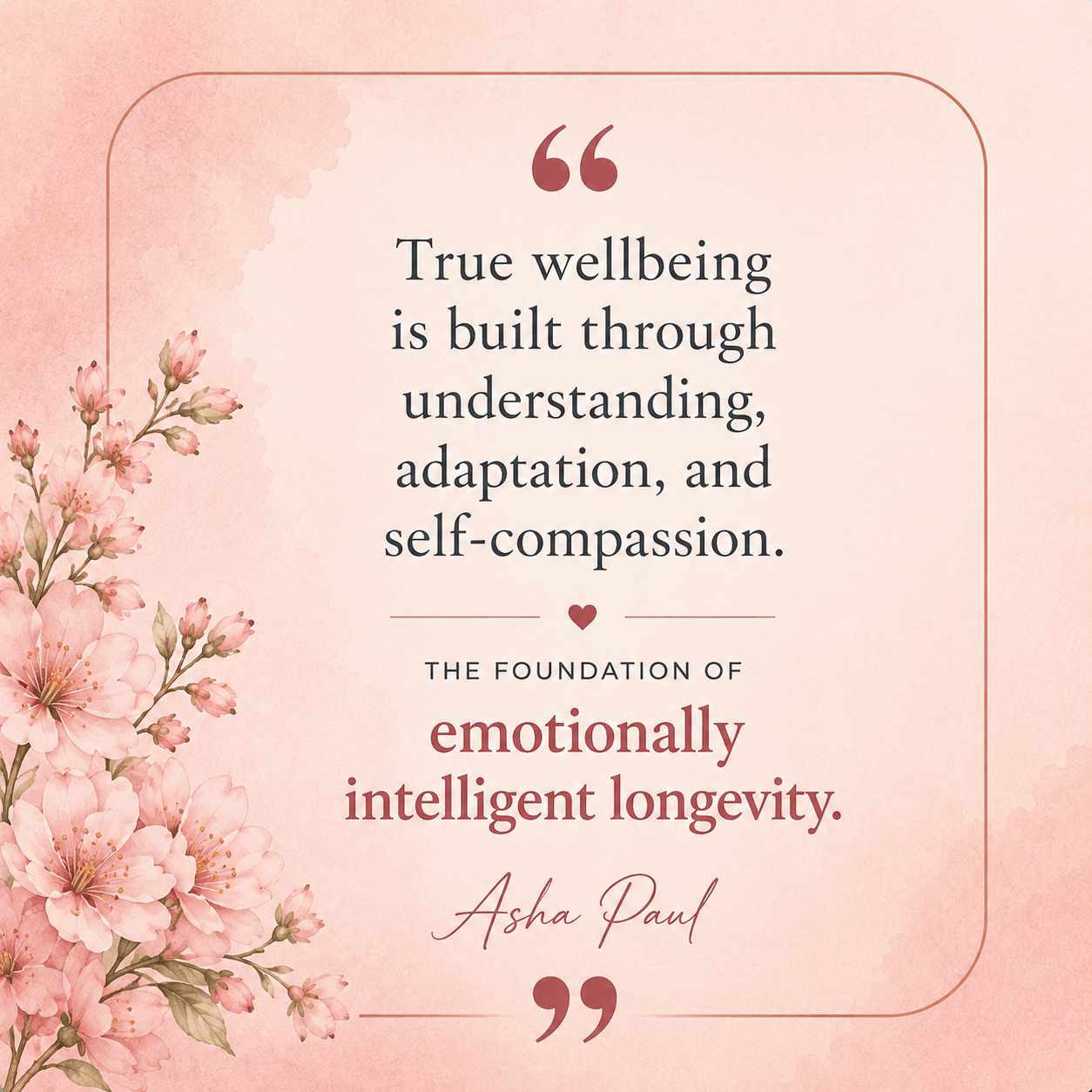
If there is one thing I have learned over the years, it is that true wellbeing is rarely found through deprivation, perfectionism, or chasing someone else's version of health.
It is built through understanding.
Understanding what nourishes your body.
Understanding how your needs evolve over time.
Understanding that food can be a source of strength, vitality, enjoyment, connection, and healthy aging rather than something to fear, control, or constantly negotiate with.
That is one of the reasons I created Cooking Club.
In Cooking Club, we explore both simple everyday meals and more elaborate recipes—from fresh plant-forward dishes to globally inspired favorites such as Asha's Madras Chicken and lamb kebabs—while discovering the nutritional benefits of the ingredients used in every class.
Together, we explore practical ways food can support healthy aging, digestion, energy, bone health, vitality, and the emotional resilience that contributes to what I call emotionally intelligent longevity.
Because the goal is not simply to follow recipes.
It is to develop greater confidence, understanding, and wisdom in your relationship with food—and to enjoy the process of nourishing yourself along the way.
Ready to build a healthier relationship with food?
Join Cooking Club and discover practical ways to support healthy aging, vitality, and emotional wellbeing.